On Portraiture and Presence
An artist's statement on what it means to truly see a subject — and to be seen in return.
A personal reflection on choosing the rooster as the singular subject of a life's work in photography.
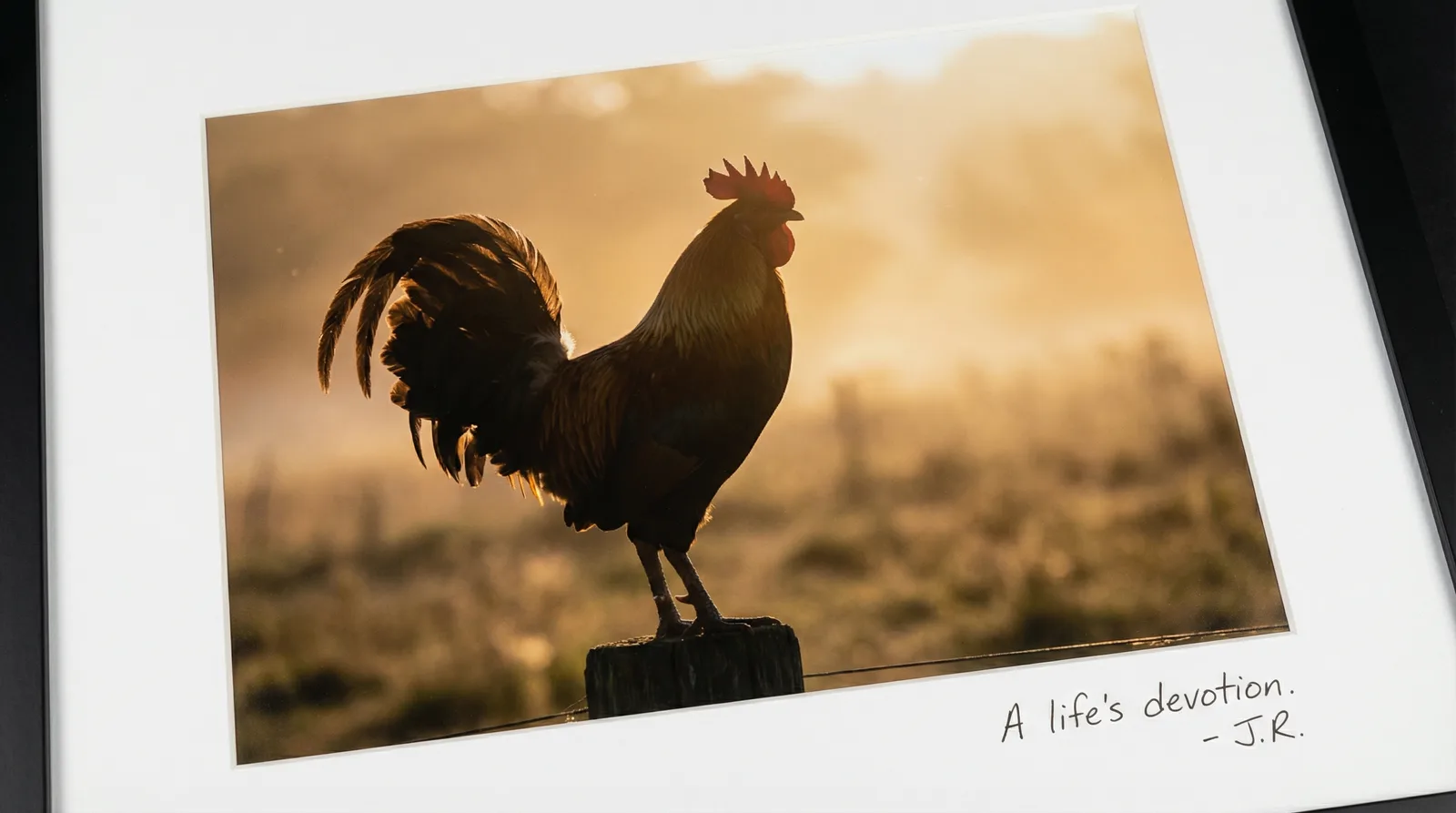
A rooster in contemplative pose, shot from a low angle with soft backlight
The question arrives at every dinner party, every gallery opening, every interview. It arrives with a smile, sometimes a raised eyebrow, always the unspoken assumption that the answer will be amusing. It never is.
I did not set out to photograph roosters. No one does. My early career was conventional — fashion editorial, commercial portraiture, the occasional art-directed campaign for brands whose names you would recognize. The work was competent, well-received, and entirely without soul.
The shift happened in 1994, in Clerkenwell, in a studio I had rented for something else. A fashion test had been cancelled that morning, the lights were already up, and a friend had left a Leghorn in my care for the afternoon. The circumstances are a story for another time. He walked onto the paper, stopped exactly where the light fell, and regarded me with an expression I can only describe as complete self-possession.
I raised the camera. He did not move. The resulting image — thirty seconds of available light, no preparation, no art direction — contained more truth than anything I had produced in ten years of professional practice. I called it The Patriarch. It is still the first print in the archive.
What I recognized in that moment, and what has sustained this work ever since, is that the domestic rooster possesses a natural dignity that most human subjects spend their entire sitting trying to manufacture. The carriage of the head. The considered, unhurried movement. The way light plays across plumage with a complexity that defeats the most sophisticated studio setup.
These are not cute animals arranged in funny costumes for the amusement of a knowing audience. These are portraits of beings who carry themselves with an authority that most CEOs can only approximate. The wardrobe — the suits, the tweeds, the evening wear — exists not to impose humanity upon them but to create a visual language through which their inherent gravitas can be more readily perceived.
I begin every sitting in silence. I enter the studio, set the lights, and wait. The subject arrives on his own terms. There is no direction, no coaxing, no manipulation. I am there to observe and to record. The composition reveals itself.
This approach demands patience and a willingness to fail. Many sessions produce nothing usable. Some produce a single frame that justifies weeks of preparation. I have learned to accept this ratio, because the alternative — forcing the image, directing the subject, imposing a vision — produces work that is technically accomplished and emotionally vacant.
Why roosters? Because they cannot pretend, and do not try. Because their beauty is complex, architectural, and earned through millennia of genetic refinement. Because in their presence, the camera becomes what it was always meant to be: a tool for seeing, not for constructing.
I photograph them because they taught me how to see. Everything else is detail.